Saint Anthony's Road
Most marathons are named after a city or a sponsor. This one was named after a road, and the road was named after a journey made in 1231 by a dying man on an ox cart. The essay below gives the clearest statement of why the course ran where it ran.
Why these 42 kilometres
Runners cover 42.195 km which are quite special, not only because the route crosses two provinces and joins all its participants in solidarity, inside and outside the race, but because during the thirteenth century the most famous and best-loved Saint in the world bound his name for ever to this land and to the road between Camposampiero and Arcella, a quarter of Padua.
Between May and June 1231, after the weariness of Lent and Easter preaching in Padua, friar Anthony lodged for a short period of rest at the Franciscan settlement in Camposampiero, in the surroundings of the castle belonging to a powerful local feudatory, a vassal of the free city of Padua. On 13 June of that year Anthony, dying on a cart pulled by oxen, covered the 18 km which divide Camposampiero from Padua, and died at Arcella, at the gate of the city.
The road of the Saint, the stage of the race, reminds everyone who passes along it of the religious for antonomasia, who dedicated his life to preaching the Gospel and to the poorest and the neediest, with a particular love for children. Those who cover that road complete a devotional path, a sort of pilgrimage, which reaches the Anthonian sanctuaries at Camposampiero and ends at the finish line in Prato della Valle, the huge square beside the famous Basilica. This religious and cultural history confers on the marathon an original character, in a setting of beauty and sacrality.
The sanctuaries along the way
Three sanctuaries mark the road, and all three are still open, still visited, and still perfectly ordinary places to stop.
The Santuario del Noce at Camposampiero was raised on the spot where tradition says the Saint preached to the crowd from a walnut tree — the tree gives the sanctuary its name — and where he is said to have had a hut built among the branches so that he could withdraw and pray. The Santuario della Visione, a short walk away, shelters the cell in which, according to the account of the friar who was with him, he saw the Christ Child. It is a small room, and its smallness is the point.
At the far end of the road, the Santuario dell'Arcella, also called the Santuario del Transito, was founded in memory of the first place in Padua that received the friar in 1227 and gave him hospitality, and where he died in 1231. Arcella was then outside the walls; today it is a busy quarter a few minutes north of the station, and the sanctuary sits in the middle of it.
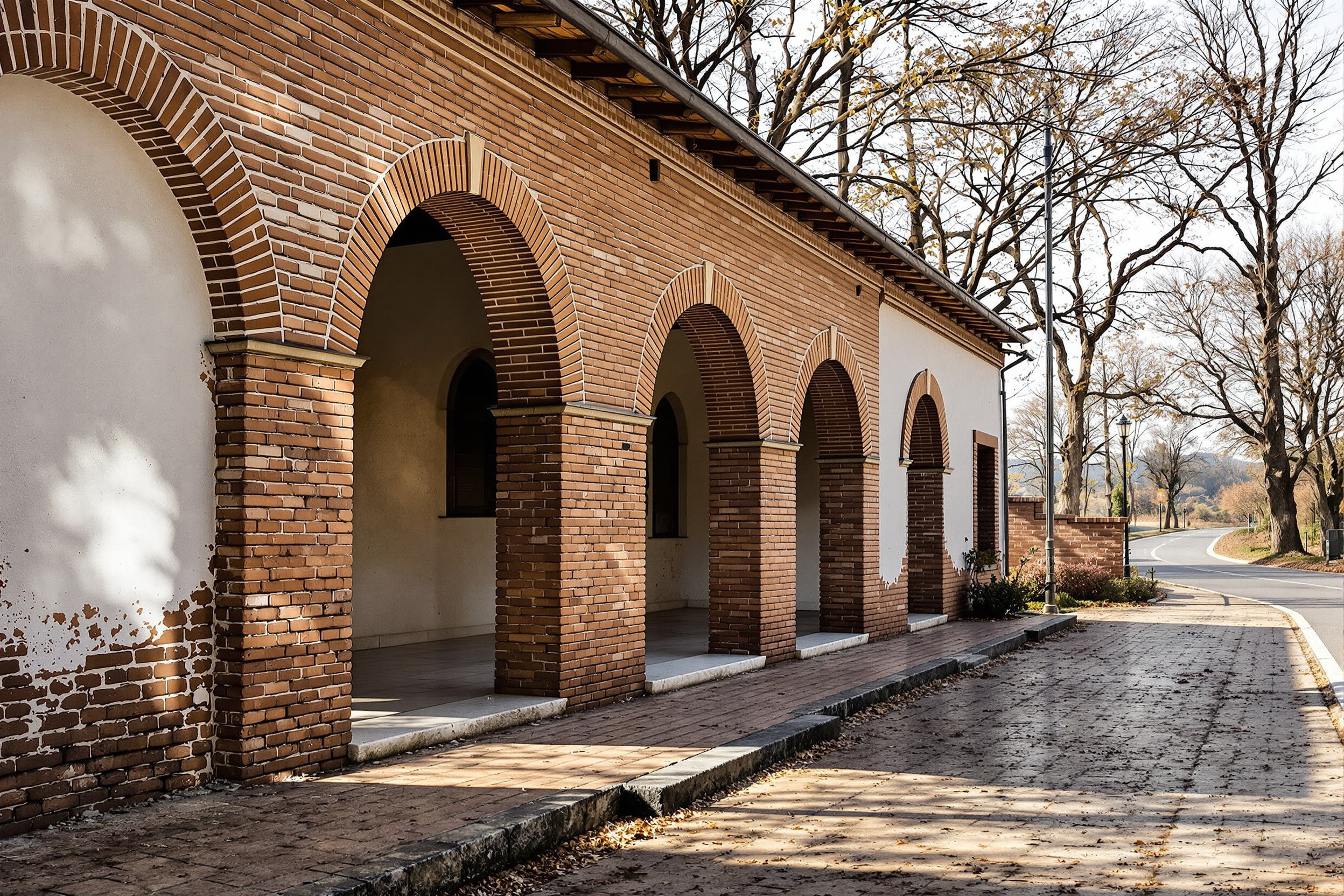
Prato della Valle and the Basilica
Anthony was canonised by Pope Gregory IX less than a year after his death — one of the swiftest canonisations on record — and construction of the Basilica del Santo began immediately afterwards, to hold his tomb. The finish line in Prato della Valle stands a few hundred metres from it, and the last kilometre of the marathon, whichever of the three courses was in use, always ended within sight of the domes.
That corner of the city is dense with the things people travel to Padua for: the Basilica, Santa Giustina on the south side of the square, the Orto Botanico — the oldest university botanical garden in the world, founded in 1545 — and, a walk to the north, the Cappella degli Scrovegni. A runner who finished at eleven in the morning could see all of it before dinner, and many did.
The road today
The Via del Santo is not a preserved monument. It is a working provincial road across the flat land north of Padua: dead straight for long stretches, lined with ditches and poplars, running between the campanili of one village and the next, past workshops and warehouses and the ribbon of houses that has grown along it since the 1960s. Traffic moves quickly on it. The roundabouts are new.
And yet the shape of the journey survives, because the geography has not changed. It is 18 km from Camposampiero to Arcella, the ground falls very gently the whole way, and the plain opens out exactly as it did in 1231. Pilgrims still walk it, in ones and twos, at their own pace and in their own time; cyclists use it constantly. For the marathon it was simply the last third of the course — the section where the plain gives way to the suburbs and the crowd begins.
Whatever a runner believed, the road did the same thing to everybody: it gave the last hour of the race a direction and a destination older than the race itself. Practical information for visiting the city is published by the Padua tourist board.
The Italian pages cover this material in more depth: see la Via del Santo and Padova. The road as the marathon used it is described on the course page, and the wider story of the race on the English home page.